My wife’s first car was a 2013 Chevrolet Aveo 1.6 sedan. In Korea it was called the Aveo; in North America the same car was sold as the Chevrolet Sonic. We drove it from 2013 to 2016 and put a little over 30,000 km (about 19,000 miles) on it.
This is a long-term owner review written from memory, so a few details may be slightly off. Note that this was the Korean-market 1.6L naturally aspirated version. US Sonics came with a 1.8L or a 1.4L turbo, so engine and transmission behavior may differ from what American owners experienced. It matches more closely with 1.6L Aveos sold in Europe, Australia and Latin America.
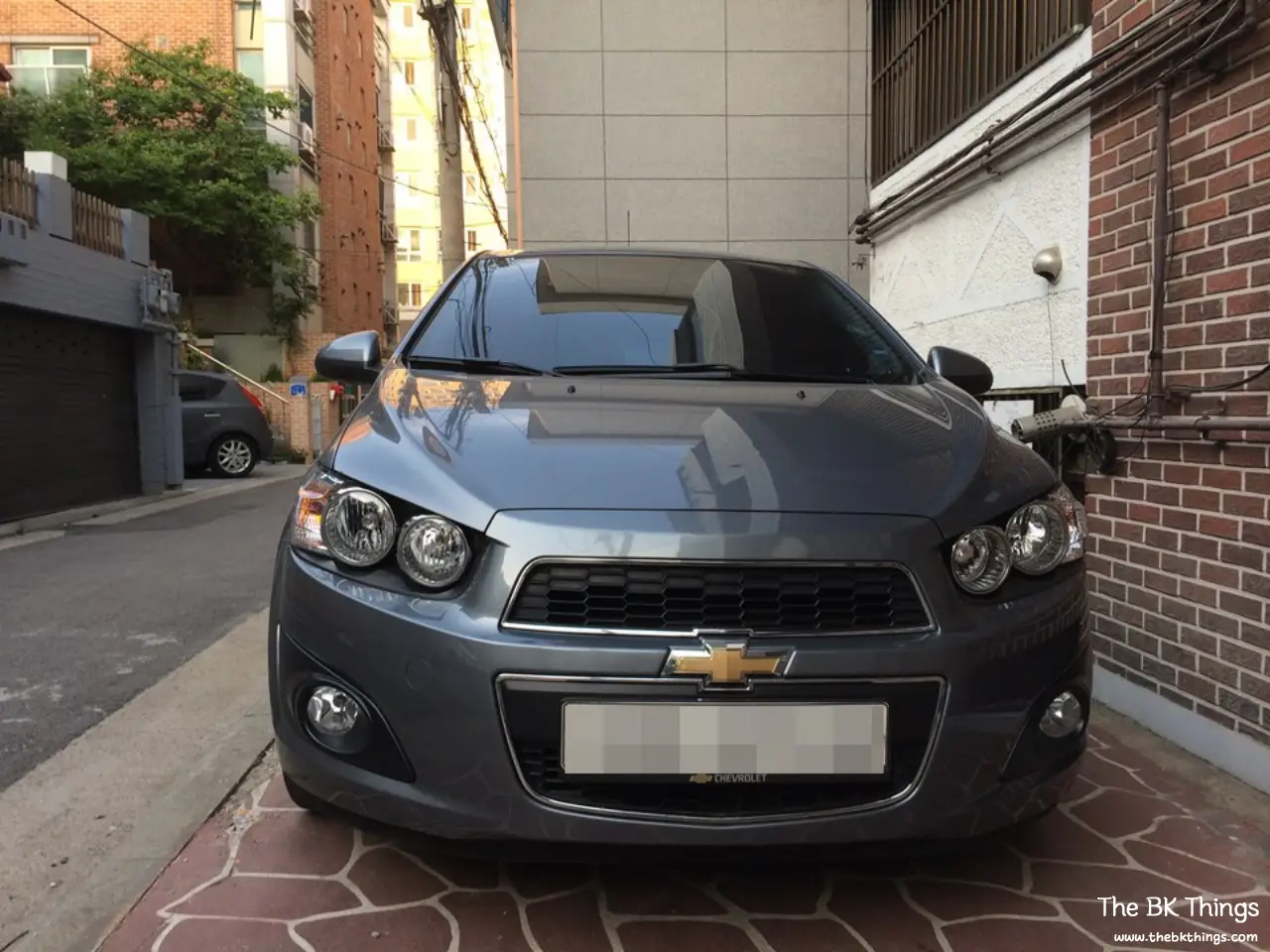
Why We Bought the Aveo
We started by looking at Korean city cars (the Kia Morning, Chevrolet Spark and Kia Ray), test-driving them through car-sharing services. I liked the boxy Ray for its space, but my wife found it uncomfortable to drive, so we moved up a class.
Subcompacts were awkwardly priced in Korea back then. They cost only a little less than compacts like the Hyundai Elantra (Avante) and Kia K3 (Forte). Our final shortlist was the Kia Pride (Rio), the Chevrolet Aveo and the Kia K3.
We chose the Aveo 1.6 LT sedan and paid about 15.7 million KRW. On paper it was the worst deal. The same-priced Kia Pride had push-button start, hill-start assist, full automatic climate control, auto headlights and rain-sensing wipers, and the K3 cost only about a million won more with far more space and equipment.
The decision was entirely my wife’s. She didn’t like how the Pride drove, and when she noticed that the much larger K3 weighed less than the Aveo, she went with the Aveo. It also helped that the Aveo sold only around 100 units a month in Korea, so it felt a little unique, and it was easy to drive. She loved it, and I was satisfied too. That good experience is probably part of why we later bought a Chevrolet Orlando.
Engine: Ecotec 1.6 Naturally Aspirated
In 2013, rival 1.6L engines were direct-injection units making 130+ hp. The Aveo’s Ecotec 1.6 MPI engine made just over 100 hp in Korean spec (the price list says 114 ps). It was an old, proven GM engine with nothing special to say about it. It had enough power for daily driving and was hard to criticize.
One issue: we occasionally found an oil leak where the engine and transmission meet. It was fixed once under the free Chevrolet warranty.
The Gen II 6-Speed Automatic: Not Very Smart
The biggest complaint about the Aveo at the time was its 6-speed Gen II automatic. The earlier Gen I transmission had such a bad reputation in Korea that it earned a nickname from Korean owners.
I would call the Gen II “not very smart.” Accelerating smoothly and cruising around 100 km/h was perfectly fine. Stop-and-go driving was frustrating. It seemed tuned for fuel economy: by 60 km/h it was already in 6th gear. Pulling away from a light, it upshifted before the revs could build, so initial acceleration felt sluggish until about 45 km/h. For quick starts I used the toggle-style manual shift on the gear lever, which was awkward.
The worst situation was climbing highway on-ramps and overpasses. After the climb, the transmission often failed to recognize that the road had leveled out and stayed in a low gear with the revs screaming. Pressing the throttle just made noise without much acceleration, which got risky when merging into fast traffic. I learned to lift off and wait for it to upshift. The Chevrolet service center scanned the transmission and said it was normal; resetting the ECU didn’t help.
Interestingly, our Orlando LPG also uses a Gen II transmission and has none of these issues. My guess is that the Gen II simply wasn’t a good match for a 100-hp naturally aspirated engine.
Rear Drum Brakes
The Aveo had rear drum brakes, while rivals like the Hyundai Accent and Kia Pride had rear discs, so it took criticism. In practice I had no complaints. I braked hard a few times, and the car stopped well and stayed straight. The brake feel was linear, building as you pressed the pedal rather than biting hard at the top like many Hyundai/Kia cars of that era.
Interior, Seats and Instrument Cluster
The front cabin felt airy thanks to the tall roof. The seats were surprisingly thick and comfortable, though narrow and without lumbar adjustment. The faux leather tended to wrinkle where you sit; I personally think cloth would have been better.
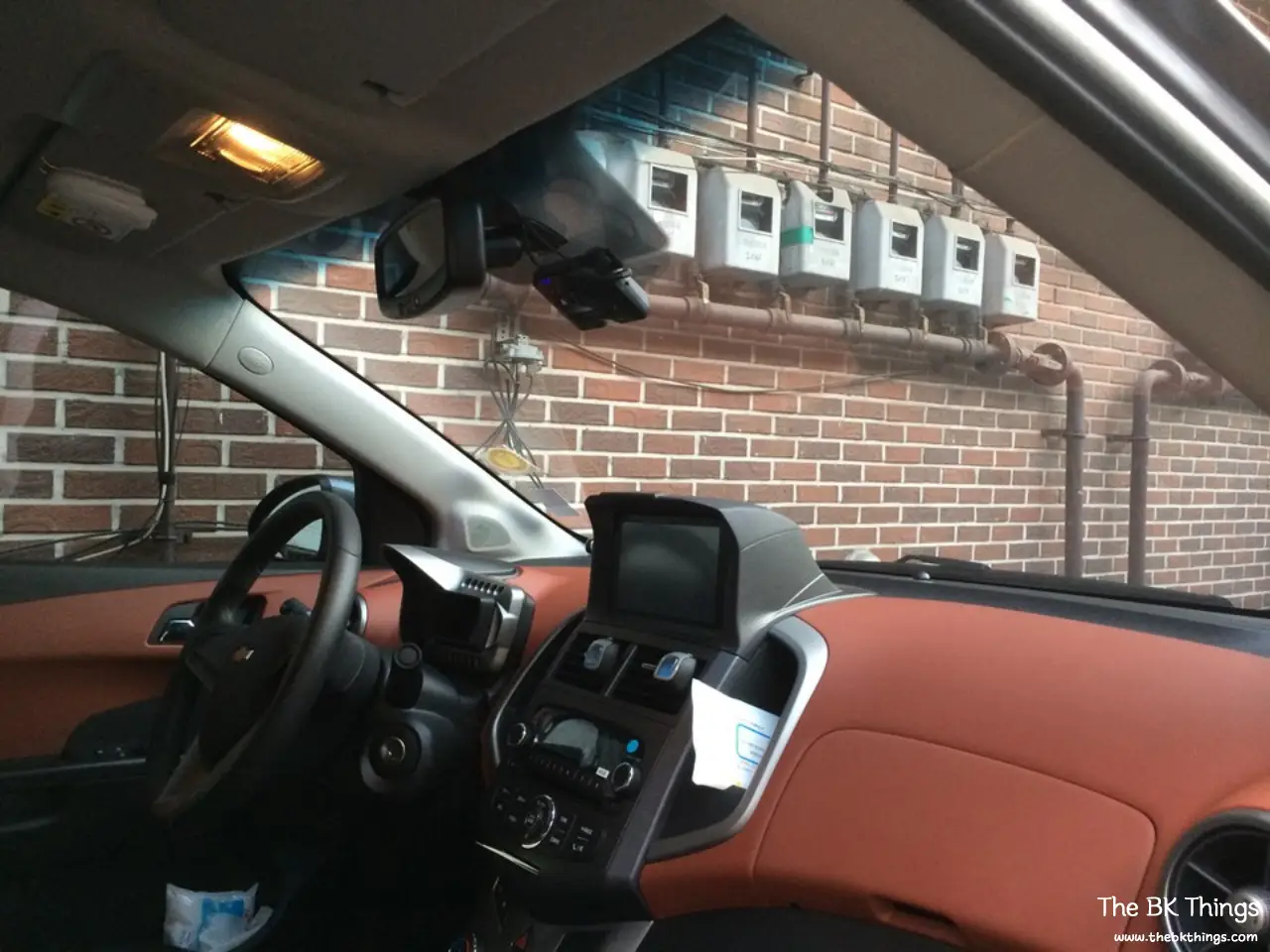
The dashboard feels far from your upper body, as if the seat is set further back. The “motorcycle-style” cluster was widely mocked, but apart from lacking a coolant temperature gauge, it was easy to read.
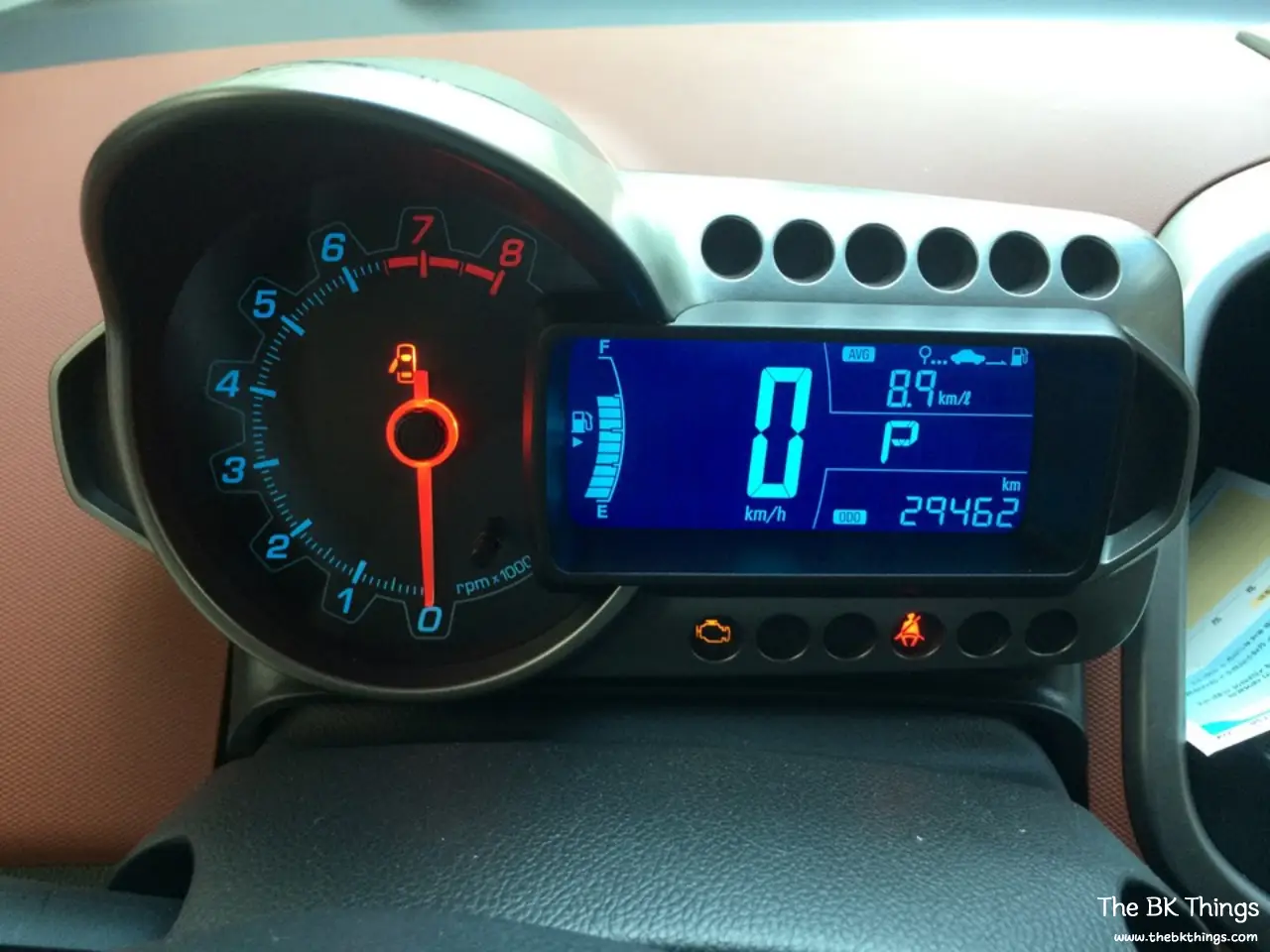
The photo above shows the cluster at 29,462 km with an average of 8.9 km/L (about 21 mpg US) at that point.
Rear Visibility and Small Annoyances
Rear visibility was poor because of the very thick C-pillars, so I relied heavily on the backup camera. The front door glass also moved close enough to the armrest that you could feel it with your elbow. Power-folding mirrors were not available, which seems to be a Chevrolet habit.
Rear Seat
The rear seat was the car’s weak spot. With a wheelbase of about 2,525 mm, legroom was acceptable, but the seatback was very upright and the cushion and back were short. It was clearly designed around folding rather than comfort. Compared to the Accent or Pride it was noticeably worse, and we kept a cushion in the car. Tall passengers around 180 cm found it uncomfortable.
Noise and Ride Comfort
The first thing that surprised me was how quiet it was. There was almost no vibration in Drive at a stop, though some crept in as the mileage grew. Wind noise from the windows was impressively low, even compared to our Kia Optima at the time. The rear, however, let in a lot of road and wheel-arch noise; under the trunk floor there was almost no sound insulation.
The ride felt very stiff at first but settled after about 1,500 km. Overall it was firm. Up front it was fine, apart from jolts over expansion joints on bridge-heavy highways. In the rear, with a short wheelbase, a torsion beam and firm tuning, long rides were tiring.
Handling and Highway Driving
Chevrolet marketed the Aveo in Korea as a “fun to drive” car, and I mostly agree. The steering had almost no play and the EPS was precise, so the car followed your inputs immediately. It went through corners at speed without needing to slow down. The only thing holding it back was the slow transmission; I suspect the later 1.4 turbo with a manual was genuinely fun.
On a side note, a few designated drivers I hired after dinners took corners far too fast because the car felt so planted, while we were sliding around in the back. I eventually stopped taking the Aveo to nights out.
Highway driving was satisfying. Acceleration ran out above about 120 km/h, but it never felt unstable. Smooth highways were comfortable; bridge joints sent the body floating a bit. I wonder whether 15-inch wheels would have been better than the LT’s 16-inch wheels.
Fuel Economy
At the time, the Aveo was the second most fuel-efficient 1.6L car in Korea. Real-world numbers:
- 80–100 km/h cruising: 15–16 km/L (about 35–38 mpg US)
- City driving: 8–9 km/L (about 19–21 mpg US)
- Overall average with about 70% highway driving: 13 km/L range (about 30 mpg US)
Not bad, not great.
Surprising Strengths
A Huge Trunk
Chevrolet barely advertised it, but the trunk is listed at over 500 liters, which is close to a midsize sedan. It is deep and tall for a sedan. We actually started camping with the Aveo and fit a large tent and a full set of gear using the trunk and rear seat. I do wish they had given some of that space to the rear seat so the backrest could recline more.
Driver-Only Unlock
Pressing the remote once unlocks only the driver’s door; press twice to unlock all doors. It confused me at first, but it is a nice safety feature. Our Orlando works the same way.
Local Shops Weren’t Ready for It
At my regular independent garage, the first oil change couldn’t include old-oil extraction because they didn’t have the right tool. The owner joked that the car was like an import. They had the tool by the next visit.
Price and Trims
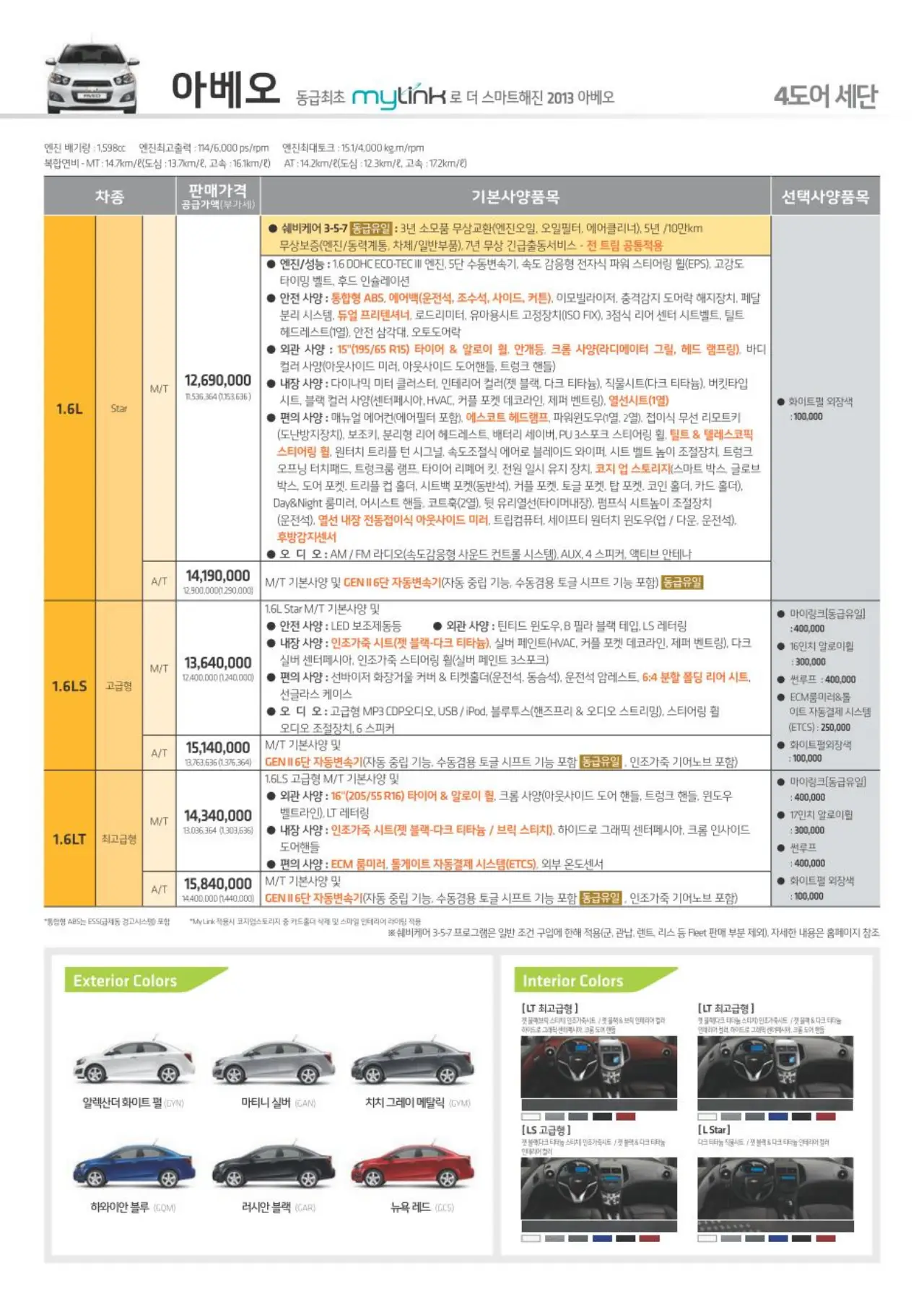
The 2013 Korean-market Aveo sedan came in three trims (approximate USD at roughly 1,400 KRW/USD):
| Trim | Manual | Automatic |
|---|---|---|
| 1.6 Star | 12,690,000 KRW (≈ $9,100) | 14,190,000 KRW (≈ $10,100) |
| 1.6 LS | 13,640,000 KRW (≈ $9,700) | 15,140,000 KRW (≈ $10,800) |
| 1.6 LT | 14,340,000 KRW (≈ $10,200) | 15,840,000 KRW (≈ $11,300) |
Our 2013 car still had the 1.6 naturally aspirated engine. When the 1.4 turbo and facelift arrived, prices rose by around 2 million KRW, which was enough to buy a base Kia K3 with equal or better equipment. Sales fell even further, the Trax eventually replaced it, and the Aveo/Sonic was discontinued worldwide.
Known Issue: Cooling System
Like many naturally aspirated engines of that era, the Aveo 1.6 has a known cooling system weak point. Replacing one inexpensive rubber seal early can prevent it, but owners who miss it can face a much larger repair bill. Chevrolet Korea never proactively informed owners, which was disappointing. If you’re buying a used Aveo/Sonic 1.6, check the cooling system history. In general, Chevrolet automatics of this period also benefit from shorter transmission fluid change intervals.
Selling It
After about 30,000 km, we sold the Aveo through a dealer when my wife bought her next car. Compared with a Hyundai or Kia in similar condition and mileage, the offer was over a million KRW lower. That made me understand why Koreans keep buying Hyundai and Kia.
Verdict: A Great Car for Two
If you don’t drive long distances, the Aveo is an excellent car for one or two people, closer to a true city car than many small cars. It was easy to drive, the front ride was fine, and the trunk made it practical. The rear seat is the big compromise. As a second car for school runs and errands, I still think it makes sense.
- Pros: precise steering, fun handling, quiet front cabin, comfortable front seats, huge trunk, stable on the highway
- Cons: sluggish Gen II automatic tuning, uncomfortable rear seat, rear road noise, poor rear visibility, weak value versus rivals
- Check when buying used: cooling system seals, oil leaks between engine and transmission, transmission fluid history
More Car Posts
- Chevrolet Orlando LPG Solenoid Valve Replacement: Check Engine Light Fix
- Mercedes-Benz A200 (W176) Long-Term Review After 10,000 km
- How to Activate Apple CarPlay and Android Auto on a Mercedes A-Class W176 (NTG5S1)